

TL;DR:
- LiFePO4 batteries last three to six times longer than lithium-ion batteries, making them ideal for camping. They offer safer operation with higher thermal runaway thresholds and better heat tolerance, especially in enclosed spaces. Although more expensive upfront, LiFePO4 delivers lower long-term costs and environmental benefits through extended use and sustainable materials.
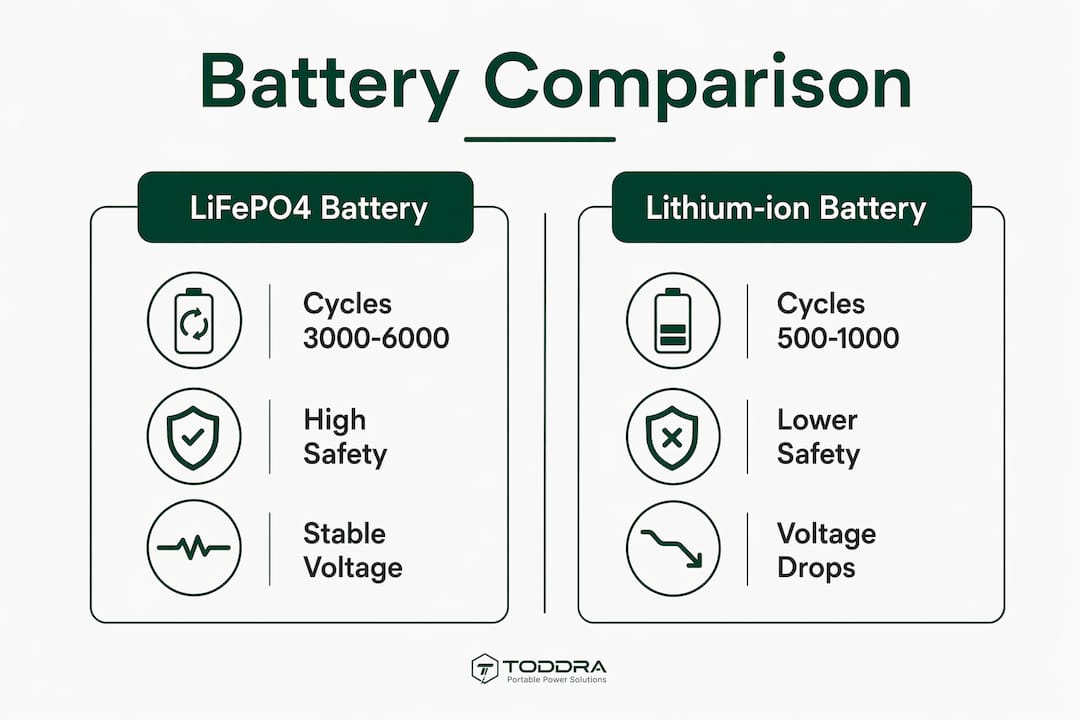
LiFePO4 (lithium iron phosphate) is the superior battery chemistry for camping, delivering 3,000–6,000 charge cycles compared to the 500–1,000 cycles typical of traditional lithium-ion. That gap explains why serious campers, RV owners, and van lifers are switching fast. The chemistry difference is real: LiFePO4 uses an iron phosphate cathode that stays stable under heat, physical stress, and deep cycling. Traditional lithium-ion uses cobalt or nickel-based cathodes that degrade faster under those same conditions. If you want reliable, long-lasting power at your campsite, understanding why LiFePO4 beats lithium ion camping setups is the first step toward making a smarter investment. Toddra carries a full range of LiFePO4-powered portable power stations built for exactly this kind of use.
Why LiFePO4 beats lithium ion camping: lifecycle and durability
The single biggest advantage of LiFePO4 for campers is cycle life. LiFePO4 batteries deliver 3,000–6,000 cycles versus 500–1,000 for standard lithium-ion. That is a 300%–600% increase in usable lifespan. For a camper who charges and discharges a battery every weekend, that difference translates to years of additional service before a replacement is needed.
Camping is hard on batteries. You deal with temperature swings, irregular charging schedules, and deep discharges when you run appliances until the power runs low. Traditional lithium-ion batteries degrade quickly under those conditions. Operating lithium-ion above 95°F can halve its cycle life, while LiFePO4 tolerates heat up to about 113°F (45°C) with minimal degradation. That matters enormously if you camp in the Southwest in summer or park your van in direct sun.
Real-world performance is worth noting honestly. Under actual camping conditions, LiFePO4 cycle life tends to land closer to 3,000 cycles rather than the high end of manufacturer claims. Temperature swings, varied load patterns, and inconsistent charging all pull the number down. Even so, 3,000 cycles is three to six times what you get from a standard lithium-ion pack.
| Metric | LiFePO4 | Traditional lithium-ion |
|---|---|---|
| Cycle life | 3,000–6,000 cycles | 500–1,000 cycles |
| Heat tolerance | Up to ~113°F (45°C) | Degrades above 95°F |
| Real-world camping cycles | ~3,000 | ~500–800 |
| Replacement frequency | Every 8–15 years (typical) | Every 2–4 years (typical) |
Pro Tip: Avoid storing your LiFePO4 battery at full charge for weeks at a time. Storing at around 50%–80% capacity extends cell longevity between camping trips.
What safety advantages does LiFePO4 offer over lithium-ion in camping?
Safety is where LiFePO4 separates itself most clearly from traditional lithium-ion. LiFePO4 has a thermal runaway threshold of approximately 270°C (518°F), compared to 150°C–210°C for standard lithium-ion. Thermal runaway is the chain reaction that causes batteries to overheat, catch fire, or explode. A higher threshold means a much larger safety margin before things go wrong.
That margin matters most in enclosed spaces. Tents, RV cabins, and cargo vans trap heat and limit airflow. A battery that reaches thermal runaway in those conditions creates a serious fire risk. LiFePO4 chemistry also remains cool during discharge, which reduces overheating risk even when ambient temperatures are high or the battery is under physical stress from rough roads or trail vibration.
Key safety advantages of LiFePO4 for camping environments:
- Thermal runaway threshold: 270°C vs 150°C–210°C for lithium-ion, giving you a much wider safety buffer.
- Stable under physical stress: LiFePO4 cells resist puncture and impact better, reducing risk during transport on rough terrain.
- Cool during discharge: The chemistry generates less heat during use, which is critical in enclosed sleeping and living spaces.
- No cobalt: Cobalt-based cathodes in lithium-ion are more chemically reactive and prone to instability at elevated temperatures.
- Safer in RVs and vans: The combination of heat tolerance and low discharge heat makes LiFePO4 the recommended chemistry for enclosed mobile living.
The peace of mind that comes with LiFePO4 is not abstract. When you are sleeping six feet from your power station in a tent or a van, the chemistry of your battery is a real safety consideration.
How do cost and environmental factors compare for outdoor use?
LiFePO4 batteries cost 20%–40% more upfront than comparable lithium-ion units. That number stops a lot of campers from making the switch. The cost-per-cycle picture tells a different story. LiFePO4 delivers a cost-per-cycle 60%–75% lower than lithium-ion because the battery lasts so much longer. Spread the purchase price across 3,000 cycles instead of 800, and LiFePO4 is the cheaper option by a wide margin.
For a camper who uses a power station 100 times a year, a lithium-ion battery may need replacement in five to eight years. A LiFePO4 unit at the same usage rate could last 30 years at the lower cycle estimate. You buy it once and stop thinking about it.
The environmental case is equally strong. LiFePO4 avoids cobalt and nickel, two materials linked to environmentally damaging and sometimes unethical mining practices. For campers who spend time in nature and care about protecting it, that distinction carries real weight. Choosing LiFePO4 aligns your power source with the values that brought you outdoors in the first place.
Pro Tip: When comparing battery prices, divide the total cost by the rated cycle life to get a true cost-per-cycle figure. A $600 LiFePO4 battery at 3,000 cycles costs $0.20 per cycle. A $400 lithium-ion battery at 800 cycles costs $0.50 per cycle. The math favors LiFePO4 every time.
Setting up a solar panel campsite system alongside a LiFePO4 battery amplifies both the cost savings and the environmental benefits. You charge for free from the sun and avoid grid power entirely.
What practical performance differences should campers expect?
Performance in the field is where LiFePO4 earns its reputation. The most important practical difference is voltage stability. LiFePO4 maintains a flat discharge curve, delivering consistent voltage from full charge down to nearly empty. Traditional lithium-ion voltage drops steadily as the battery drains. That drop causes appliances, lights, and devices to shut down or perform poorly before the battery is actually empty.
Flat voltage means your camp lights stay bright, your CPAP machine runs at full pressure, and your mini fridge holds temperature right up until the battery needs a recharge. With lithium-ion, you often lose usable capacity because devices stop working before the battery is truly depleted.
Weight is the one area where lithium-ion holds an advantage. LiFePO4 is heavier per watt-hour. For ultralight backpackers counting every ounce, that matters. For RV campers, van lifers, and base camp setups, the weight difference is largely irrelevant. LiFePO4 is the preferred choice for stationary and semi-portable camping systems like RVs and base camps, while lithium-ion suits ultralight backpacking where weight is the primary constraint.
Cold weather performance requires planning. Charging LiFePO4 below 32°F (0°C) without a built-in heating element risks permanent damage. Discharging, however, works effectively down to -4°F (-20°C). The practical implication: in winter camping, charge your battery before temperatures drop overnight, or choose a unit with an integrated battery management system that includes a heating function.
Practical performance points for campers:
- Flat voltage curve: Appliances run at full performance until the battery is nearly empty, not just until voltage starts to sag.
- Solar compatibility: LiFePO4 accepts solar input efficiently and handles partial-state charging well, which is common with solar panels.
- Cold weather charging: Avoid charging below freezing without a heating element. Discharge in cold works fine.
- Weight trade-off: Heavier than lithium-ion per watt-hour, but irrelevant for vehicle-based or base camp setups.
- Deep discharge tolerance: LiFePO4 handles deep cycling without the accelerated degradation that damages lithium-ion cells.
Understanding how an RV solar power system works helps you pair the right battery capacity with your solar input for reliable, all-day power at camp.
Key Takeaways
LiFePO4 is the best battery chemistry for camping because it delivers more cycles, better safety, lower long-term cost, and consistent voltage compared to traditional lithium-ion.
| Point | Details |
|---|---|
| Cycle life advantage | LiFePO4 lasts 3,000–6,000 cycles vs 500–1,000 for lithium-ion, meaning far fewer replacements. |
| Safety margin | A 270°C thermal runaway threshold makes LiFePO4 significantly safer in enclosed camping spaces. |
| Long-term cost savings | Higher upfront price is offset by a cost-per-cycle 60%–75% lower than lithium-ion. |
| Voltage stability | Flat discharge curve keeps appliances running at full performance until the battery is nearly empty. |
| Environmental benefit | No cobalt or nickel means a cleaner supply chain and a better fit for nature-focused campers. |
The weight argument is a red herring for most campers
I have heard the weight objection more times than I can count. “LiFePO4 is too heavy.” For a thru-hiker with a 30-liter pack, that is a fair point. For everyone else, it is a reason to avoid a better battery that does not actually apply to their situation.
Most campers I talk to are not ultralight backpackers. They are driving to a campsite, parking an RV, or setting up a base camp for a weekend. In those scenarios, a few extra pounds in a power station is not a real burden. What does matter is whether your battery lasts through two days of cloudy weather, whether it is safe to run inside your van overnight, and whether you are replacing it every three years or every fifteen.
The misconception that “lithium is lithium” is genuinely costly. I have seen campers buy cheaper lithium-ion units expecting the same performance, then wonder why the battery degrades after two seasons of heavy use. The chemistry is fundamentally different, and the performance gap is real.
My honest advice: match the battery to your actual camping style. If you backpack and every ounce counts, lithium-ion makes sense. If you camp from a vehicle or a fixed base, LiFePO4 is the right call every time. Buy it once, treat it well, and it will outlast most of the other gear you bring.
— Jackson
Reliable LiFePO4 power for your next camping trip
Choosing the right battery chemistry is only half the decision. The other half is finding a power station that puts that chemistry to work in a well-built, dependable package.
Toddra carries a carefully selected range of LiFePO4-powered solar generators and portable power stations built for campers who need reliable energy in the field. The Jackery Solar Generator 2000 Plus delivers 2,042Wh of LiFePO4 capacity with 3,000W output, making it a strong fit for RV trips and extended base camp setups. For campers who want to browse the full range, Toddra’s solar generator collection includes options across multiple capacity levels, all backed by US-based customer support and secure checkout. Quality power should feel dependable from the moment you set up camp.
FAQ
How many cycles does a LiFePO4 battery last?
LiFePO4 batteries last 3,000–6,000 charge cycles. Under real camping conditions with temperature swings and varied loads, expect performance closer to 3,000 cycles, which is still three to six times longer than traditional lithium-ion.
Is LiFePO4 safe to use inside a tent or RV?
Yes. LiFePO4 has a thermal runaway threshold of 270°C, compared to 150°C–210°C for lithium-ion. That higher threshold, combined with low heat during discharge, makes it the safer choice for enclosed camping spaces.
Does LiFePO4 work in cold weather?
LiFePO4 discharges effectively down to -4°F (-20°C). Charging below 32°F (0°C) without a built-in heating element risks permanent cell damage, so plan to charge before overnight temperatures drop.
Why is LiFePO4 more expensive upfront?
LiFePO4 costs 20%–40% more at purchase, but its cost-per-cycle is 60%–75% lower than lithium-ion. Over years of camping use, the total cost of ownership is lower, not higher.
Is LiFePO4 better for camping than standard lithium-ion?
For vehicle-based camping, RVs, vans, and base camps, yes. LiFePO4 offers longer life, better safety, stable voltage, and lower long-term cost. Ultralight backpackers may still prefer lithium-ion for its lighter weight.