

TL;DR:
- A solar generator is a portable power system that uses solar panels and a battery to produce quiet, emission-free electricity at campsites. It offers advantages such as low noise, no fuel costs, and environmental benefits, making it ideal for many camping styles, especially in noise-sensitive areas. However, it may fall short for high-power appliances like air conditioners, where hybrid solutions with gas generators are necessary.
A solar generator is a portable power station that pairs a battery with solar panels to convert sunlight into clean, silent electricity at your campsite. Unlike gas generators, solar units produce zero exhaust emissions, operate at under 30 dB, and require no fuel runs to the nearest gas station. The solar generator benefits campsite users most when quiet hours are enforced, fire restrictions are in place, or you simply want to hear the wind instead of an engine. This guide covers every major advantage, from cost savings to environmental impact, plus practical sizing tips so you get the right setup for your adventure.
1. Solar generator benefits at the campsite: convenience and mobility
Solar generators make campsite life noticeably easier. Their compact, lightweight design means you can carry reliable power to mountain trailheads, beach sites, and backcountry clearings without hauling a gas can alongside your gear.
The silence factor is real and measurable. Gas generators emit 60–90 dB, roughly the volume of a lawnmower running next to your tent. Solar units stay under 30 dB, which is quieter than a whispered conversation. Most campgrounds enforce quiet hours from 10 p.m. to 6 a.m., and a solar generator lets you run a fan or charge devices all night without violating a single rule.
Fuel logistics disappear entirely. No measuring, no spills, no worrying about storage regulations at national parks. You set up your panels in the morning and let the sun do the work.
Here is what a typical campsite solar setup powers with ease:
- LED camp lights and lanterns
- 12V portable coolers and mini fridges
- Phone, tablet, and camera chargers
- CPAP machines for campers who need them
- Laptops and small speakers
Pro Tip: Position your solar panels facing south and tilt them at an angle equal to your latitude. A 10-degree adjustment in panel angle can recover meaningful output on partly cloudy days.
2. Environmental benefits of solar power at the campsite
Solar generators produce zero exhaust emissions during use. That single fact separates them from every gas-powered alternative on the market. Solar energy systems reduce carbon emissions by up to 70% compared to gas generators, a meaningful reduction for campers who visit sensitive ecosystems regularly.
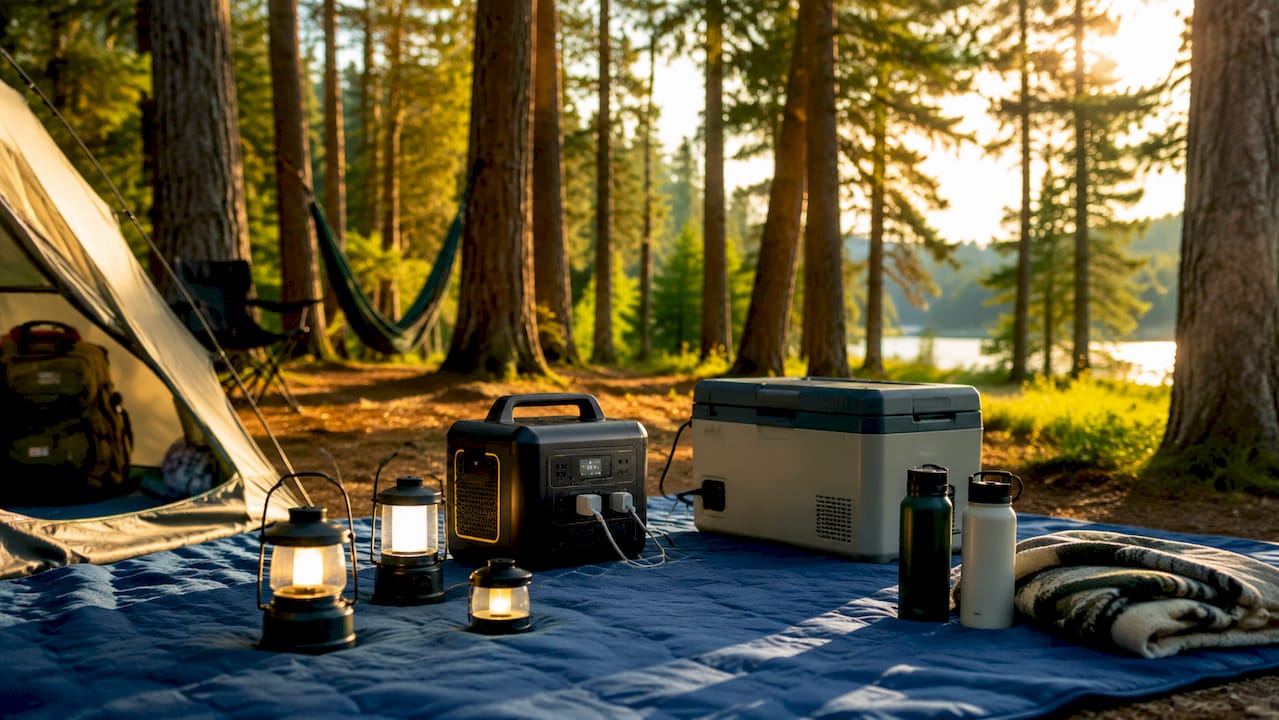
Noise pollution is an environmental issue too, not just a personal comfort concern. Gas generators disrupt wildlife behavior, particularly birds and nocturnal animals that rely on sound for navigation and communication. A solar unit running silently protects the natural soundscape you came to experience.
Solar power also aligns with EPA guidelines and most campground environmental policies. Many national forests and state parks now restrict or ban gas generator use during certain hours or in specific zones. A solar setup keeps you compliant without sacrificing comfort.
A few habits that multiply the eco-benefits of solar power for camping:
- Use Energy Star rated appliances and LED lighting to cut consumption
- Pack out all battery waste and use recycling programs for spent cells
- Choose LiFePO4 battery systems, which have longer lifespans and safer chemistry than older lithium-ion cells
- Avoid running high-draw appliances unnecessarily during peak wildlife hours
Solar panels themselves carry a 25–30 year lifespan, and most manufacturers offer battery recycling programs. The long-term environmental math strongly favors solar.
3. Cost savings and maintenance advantages
The financial case for solar generators is straightforward. After the initial purchase, your fuel cost drops to zero. Gas generators burn $2–$5 per gallon, and a weekend camping trip with moderate use can cost $15–$30 in fuel alone. Operating costs for solar camping systems are near zero once purchased, making the payback period shorter than most campers expect.
Maintenance is another area where solar wins clearly. Gas generators need regular oil changes, air filter replacements, spark plug checks, and carburetor cleaning. Solar generators have no moving parts and no fuel system. Solar units require minimal maintenance because there is simply less to break.
Lifespan comparisons favor solar too. Gas generator engines typically last 5–10 years with proper care. Solar lithium-ion battery systems last 10–25 years, and solar panels themselves often outlast the battery by a decade. That longevity changes the total cost calculation significantly.
Pro Tip: Track your actual fuel spending on gas-powered trips for one season. Most campers are surprised to find they spend more on generator fuel than on campsite fees. That number makes the solar investment feel much more reasonable.
For a detailed breakdown of what you will actually spend over time, the fuel cost comparison guide at Toddra’s blog walks through real numbers across different camping styles.
| Cost factor | Gas generator | Solar generator |
|---|---|---|
| Fuel per weekend | $15–$30 | $0 |
| Annual maintenance | $50–$150 | Near zero |
| Engine lifespan | 5–10 years | N/A (no engine) |
| Battery lifespan | N/A | 10–25 years |
| Panel lifespan | N/A | 25–30 years |
4. How to size your solar generator for camping
Sizing is where most campers make mistakes. The right approach is to treat your solar system as an energy budget, not an unlimited power source. Match battery capacity to overnight needs and use solar panels to replenish what you use during the day.
Start by calculating your total daily watt-hour (Wh) consumption. Add up the wattage of every device you plan to run and multiply by the hours of daily use. A portable cooler drawing 45W for 24 hours uses 1,080 Wh. Add phone charging (10 Wh), LED lights (20 Wh for four hours), and a laptop (60 Wh for two hours), and a typical basecamp setup needs roughly 1,200–1,500 Wh per day.
Panel sizing follows from that number. To supply 1,000 Wh per day with 5 peak sun hours, a 200W panel system is the minimum. Upgrading to 250W accounts for the 15–25% efficiency losses that occur in real-world conditions due to heat, wiring resistance, and sun angle. Peak sun hours are always fewer than daylight hours, so plan conservatively.
Inverter sizing has its own rule. Inverter capacity must be at least 20% above your largest appliance load. Running a 600W cooler compressor on a 600W inverter risks damage and tripped protection circuits. A 750W or 1,000W inverter handles that load safely.
Two common setups to consider:
- Minimalist camper: 500–700 Wh battery, 100W panel, powers lights, phone charging, and a small fan for two nights between sunny days.
- Basecamp camper: 1,500–2,000 Wh battery, 200–300W panels, powers a cooler, laptop, lights, and CPAP machine for extended stays.
For a deeper look at matching wattage to camping style, the power station sizing guide covers the math in plain terms.
5. When solar generators fall short and what to do about it
Solar generators are not the right tool for every situation. Typical solar units deliver 1,000–2,000W of continuous output. Gas generators can reach 3,000–10,000W. That gap matters when you need to run an air conditioner, a power tool, or a large RV appliance for extended periods.
Overcast conditions reduce solar output significantly. A week of cloudy weather at a forested campsite can leave your battery depleted faster than panels can recover it. In those conditions, a gas generator or a hybrid approach becomes practical.
Hybrid systems combine a solar generator for daily quiet use with a small gas generator for heavy loads or backup charging. This setup gives you the best of both worlds: silent, clean power for 90% of your needs and surge capacity when you genuinely need it.
Matching your power source to your camping style matters:
| Camping style | Best power approach |
|---|---|
| Tent camping, light loads | Solar generator only |
| RV with air conditioning | Hybrid: solar plus gas backup |
| Overlanding, variable terrain | Solar with high-capacity battery |
| Van life, extended off-grid | Solar with expandable battery bank |
Solar generators excel for low-power, long-duration, noise-sensitive camping. Gas generators remain superior for high-power, short-duration tasks. Knowing which category your trip falls into is the most useful decision you can make before you pack.
6. Safety and campground compliance
Solar generators are inherently safer at campsites than gas alternatives. They produce no carbon monoxide, which means you can run them inside a tent vestibule or a van without ventilation concerns. Gas generators cause carbon monoxide poisoning every year when used in enclosed spaces, and the CDC lists it as a leading cause of accidental poisoning deaths in the United States.
Most campgrounds with quiet-hour rules or generator restrictions specifically target gas-powered units. A solar generator operating at under 30 dB passes every noise restriction without exception. That compliance gives you freedom to camp in more locations, including primitive sites and designated quiet zones.
LiFePO4 battery chemistry, which Toddra’s product lineup emphasizes, adds another layer of safety. LiFePO4 cells are significantly more stable than older lithium-ion chemistries and are far less prone to thermal runaway. For campers storing power systems in enclosed vehicles or tents, that stability is genuinely reassuring.
Key takeaways
Solar generators deliver the best combination of quiet, clean, and cost-effective power for campsites, making them the most practical choice for most camping styles in 2026.
| Point | Details |
|---|---|
| Silent operation | Solar units run under 30 dB, meeting all campground quiet-hour rules. |
| Zero fuel costs | Operating costs drop to near zero after purchase, unlike gas at $2–$5 per gallon. |
| Long system lifespan | Solar panels last 25–30 years; LiFePO4 batteries last 10–25 years. |
| Size to your needs | Calculate daily Wh use and size panels 20–25% above minimum to cover real-world losses. |
| Know the limits | For air conditioners or power tools, a hybrid solar-plus-gas setup is the practical answer. |
Why solar changed how I camp
I spent three seasons running a gas generator at campsites before I made the switch, and the difference was immediate in ways I did not fully anticipate.
The obvious change was silence. What I did not expect was how much mental space that silence returned. Fuel-free solar generators shift your focus from managing equipment to experiencing nature, and that shift is real. I stopped thinking about fuel levels, oil checks, and noise complaints from neighboring sites. I started actually listening to the campsite around me.
The second thing I noticed was how the setup matched my camping style once I sized it correctly. I camp with a cooler, a laptop, and lights. A 1,500 Wh system with two 200W panels covers that load comfortably for three to four days without a full sun day in between. Campers who match their solar setup to their adventure profile avoid both overspending on capacity they never use and the frustration of running out of power on night two.
My honest advice for anyone still on the fence: start with a mid-range system, track your actual consumption for one trip, and adjust from there. The learning curve is short, and the payoff in comfort and peace of mind is significant. Solar is not a compromise. For most campers, it is simply the better option.
— Jackson
Reliable campsite power from Toddra
Toddra carries a carefully selected range of solar generators built for campers who want dependable, clean energy without the noise or fuel hassle.
The Jackery Solar Generator 2000 Plus offers 2,042 Wh of capacity and 3,000W of output, enough to run a cooler, lights, and a laptop for several days on a single charge. For campers who want to browse the full range by capacity and use case, Toddra’s solar generator collection includes options from compact weekend units to high-capacity basecamp systems. Every product ships with US-based customer support and secure checkout, so you can shop with confidence and get on the road faster.
FAQ
What is a solar generator?
A solar generator is a portable battery system paired with solar panels that converts sunlight into stored electricity. It powers camping devices silently and without fuel or exhaust emissions.
How long does a solar generator last at a campsite?
Runtime depends on battery capacity and load. A 1,500 Wh system running a cooler, lights, and phone charging typically lasts two to three days, with solar panels replenishing capacity during daylight hours.
Are solar generators allowed in national parks?
Most national parks and campgrounds allow solar generators because they produce no noise above quiet-hour thresholds and no exhaust emissions. Always check specific park rules before your trip.
How do I choose the right solar generator for camping?
Calculate your total daily watt-hour consumption, then select a battery with at least that capacity and panels rated 20–25% above your minimum daily need to account for real-world efficiency losses.
Can a solar generator run an air conditioner?
Most portable solar generators cannot sustain an air conditioner for extended periods because AC units draw 1,000–1,500W continuously. A hybrid system combining solar storage with a gas generator is the practical solution for cooling-heavy camping setups.