

TL;DR:
- An indoor safe portable power station uses LiFePO4 batteries to provide clean, emission-free power inside homes. Proper safety depends on battery chemistry, protection systems, and certifications, ensuring reliable operation around the clock. Buyers should select the correct capacity, follow safe usage practices, and verify certifications for long-term safety and performance.
An indoor safe portable power station is a rechargeable battery system that delivers clean, quiet, and emission-free power inside your home. Unlike gas generators, these units produce zero carbon monoxide and no toxic fumes, making them fully safe for bedrooms, living rooms, and apartments. The best models use LiFePO4 (Lithium Iron Phosphate) battery chemistry, which offers superior thermal stability and a lifespan of 3,500 or more charge cycles. Whether you need a reliable emergency power source, a quiet backup during outages, or a portable battery station for everyday home use, understanding what separates a safe unit from a risky one is the most important decision you will make.
What makes an indoor safe portable power station truly safe?
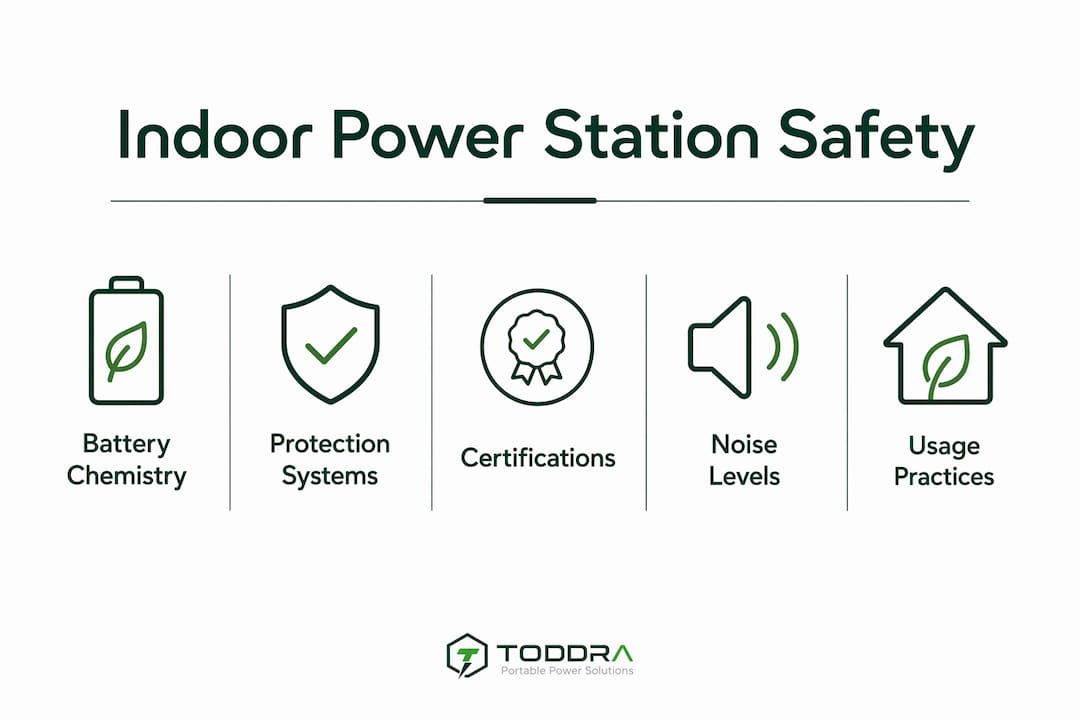
Safety in a portable power station comes down to three things: battery chemistry, protection systems, and certifications. Get all three right, and you have a unit you can run confidently inside your home around the clock.
Battery chemistry: LiFePO4 vs older lithium-ion
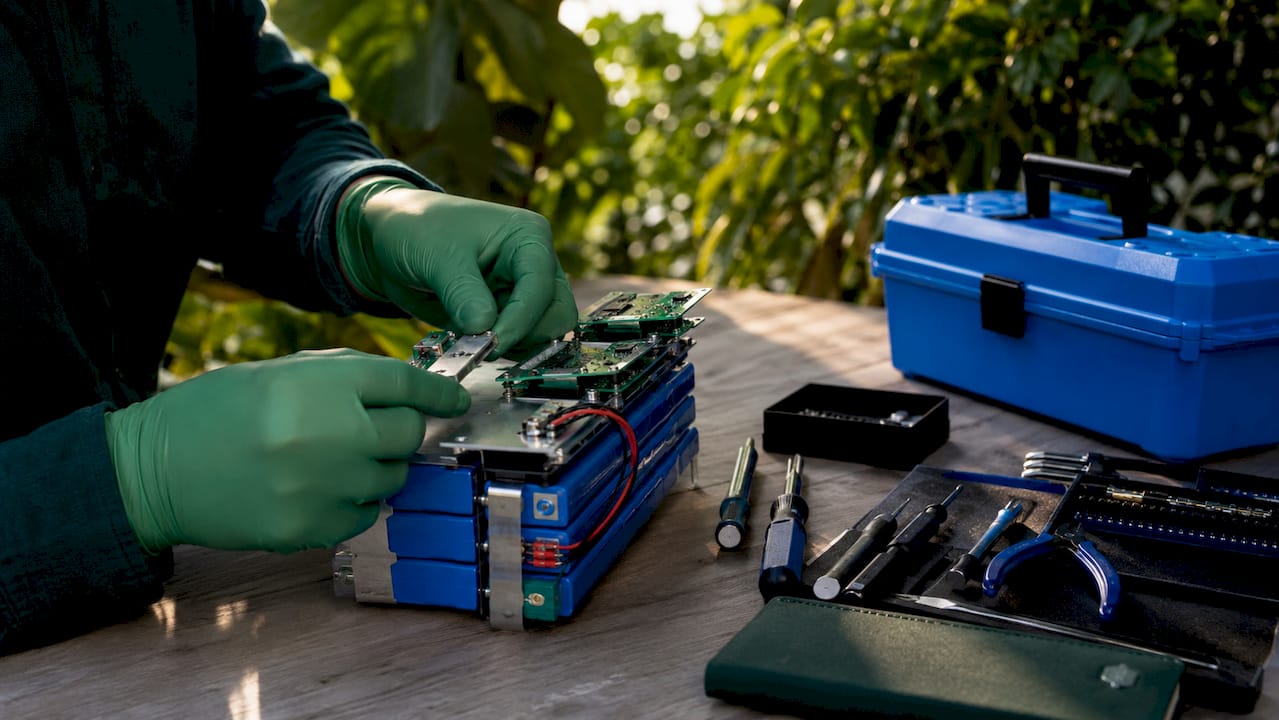
LiFePO4 batteries are far safer and more thermally stable than NMC or older lithium-ion chemistries. That stability matters because it means the battery resists overheating even under heavy load, which is the primary cause of battery fires. A quality LiFePO4 unit also delivers 3,500 or more charge cycles and a usable lifespan of roughly 10 years. That is a meaningful difference from older lithium-ion packs, which typically degrade noticeably within 500 to 800 cycles.
Battery management systems and inverter quality
Every quality indoor unit includes a Battery Management System, or BMS. The BMS actively monitors and protects against short circuits, overcharging, over-discharging, and overheating. Think of it as the safety net that keeps the battery operating within safe limits at all times. Inverter type matters just as much. Pure sine wave inverters produce clean, stable power that is safe for sensitive electronics and medical devices like CPAP machines. Modified sine wave inverters are cheaper but can damage motors, audio equipment, and medical gear over time.
Safety certifications to look for
- UL listing: Confirms the unit has been independently tested to American safety standards.
- ETL certification: An equivalent third-party safety mark accepted across North America.
- FCC compliance: Verifies the unit does not emit harmful electromagnetic interference.
- UN38.3: The international transport and safety standard for lithium batteries.
Pro Tip: Always check for a physical certification mark on the unit itself, not just a claim on the product page. Counterfeit certifications exist, and a real UL or ETL mark is stamped directly on the housing.
Noise is another indoor-specific factor. Battery power stations operate at 20–50 dB, roughly the level of a quiet conversation. Gas generators run at 65–85 dB, which is loud enough to disrupt sleep and require hearing protection over time. For indoor use, the silence of a battery unit is not just comfort. It is a genuine quality-of-life advantage.
How do you calculate the right capacity for indoor use?
Choosing the wrong size is the most common mistake buyers make. Too small and the unit shuts down mid-outage. Too large and you pay for capacity you never use.
Step-by-step capacity calculation
- List every device you plan to power. Include the wattage of each item. Check the label on the device or its manual for the rated wattage.
- Add the wattages together. This gives you your total continuous load in watts.
- Add a 20% safety margin. Multiply your total by 1.2 to account for startup surges and inefficiencies. This is the recommended method for first-time buyers.
- Apply the runtime formula. Use (Total Watt-Hours × 0.85) ÷ Device Watts to get realistic hours of runtime. The 0.85 efficiency factor accounts for inverter conversion losses, which most product specs ignore.
- Match to a capacity tier. Select a unit whose watt-hour rating covers your calculated need with room to spare.
Capacity tiers by use case
| Use Case | Recommended Capacity | Typical Devices Covered |
|---|---|---|
| Small electronics | 200–300 Wh | Phones, laptops, LED lights |
| Mid-range home backup | 1,000–1,500 Wh | Mini-fridge, fans, router, TV |
| Full home critical backup | 4,000 Wh or more | Refrigerator, medical devices, multiple appliances |
Pro Tip: Always check both the continuous watt rating and the surge watt rating. A refrigerator compressor can draw three times its rated wattage for the first two seconds on startup. A unit that cannot handle the surge will trip its protection circuit immediately.
You also need to understand power bank vs power station differences before buying. A power bank tops out at a few hundred watt-hours and charges phones. A power station handles appliances and runs on a full inverter output. They are not interchangeable for home backup.
Safe indoor usage practices everyone should follow
Placement, cord management, and routine maintenance determine whether your unit stays safe over years of use.
- Place the unit on a hard, flat surface with at least 12 inches of clearance on all sides. Avoid carpet, which traps heat underneath the unit.
- Use 12-gauge extension cords for high-draw appliances like refrigerators and space heaters. 16-gauge cords are safe only for lamps, phone chargers, and light devices. Using an undersized cord is one of the leading causes of indoor electrical fires.
- Never use coiled extension cords under load. Coiled cords concentrate heat and create a fire risk even when the cord gauge is correct. Always unroll cords fully before use.
- Store the unit at 50–80% charge if you are not using it for an extended period. Storing at 100% or 0% accelerates battery degradation. Toddra’s guide on safe power station storage covers temperature and charge level recommendations in detail.
- Keep the unit away from water sources in kitchens and bathrooms. Most indoor units carry an IP54 rating, which means they resist splashes but are not waterproof.
If you notice the unit becoming unusually warm, detect a burning smell, or see any smoke, unplug all connected devices immediately and move the unit outdoors. Do not use water on a lithium battery fire. Call emergency services and keep people away from the unit until it cools completely.
Pro Tip: If your household also uses a gas generator outdoors as a backup, install CO detectors near sleeping areas and gas appliances. CO detectors with digital ppm displays and electrochemical sensors give the earliest warning if exhaust enters the home through vents or windows.
How do you charge and maximize runtime for indoor power stations?
A portable battery station is only as useful as its charge level when you need it. Understanding your charging options keeps you prepared.
- Wall outlet charging is the most common method. Most quality units reach 80% charge in roughly 58 minutes with fast charging enabled. Full charge typically takes 1.5 to 3 hours depending on capacity and input wattage.
- Solar panel charging gives you independence from the grid. This is especially valuable during extended outages when the wall outlet is unavailable. Pair your unit with compatible solar panels rated to the unit’s maximum solar input.
- Car adapter charging works as a slower backup option. It is useful for topping off the unit during a commute but is not practical as a primary charging method for large-capacity units.
- App-based monitoring lets you track charge status, output wattage, and estimated runtime from your phone. This is particularly useful during outages when you want to prioritize which devices stay on.
- Temperature affects charging performance. Charging below 32°F (0°C) can damage lithium cells permanently. Most units with a quality BMS will pause charging automatically in freezing conditions, but storing the unit in a temperature-controlled space is the better practice.
Battery power stations support charging via wall outlets, solar panels, and car adapters, which gives you genuine flexibility across different scenarios. The key to maximizing battery longevity is avoiding full discharge cycles. Keeping the battery between 20% and 90% for routine use extends the total number of usable cycles significantly.
Common mistakes that compromise safety and performance
Most problems with indoor power stations trace back to a small number of avoidable errors.
- Using undersized extension cords. This is the single most dangerous mistake. Longer cords also increase voltage drop, which causes the unit to work harder and generate more heat. Keep cord runs as short as possible.
- Ignoring manufacturer storage guidelines. Storing a unit fully charged in a hot garage through summer will degrade the battery faster than a full year of normal use.
- Overloading beyond rated wattage. Running devices that exceed the unit’s continuous output rating triggers the protection circuit. Repeated overloading stresses the BMS and shortens its service life.
- Assuming all inverters are equal. A modified sine wave inverter will run a lamp without issue but can damage a CPAP machine, laser printer, or variable-speed motor over time. Pure sine wave output is the standard to require for any unit powering medical or sensitive electronics.
- Skipping periodic inspections. Check the unit’s casing, ports, and cables every few months for signs of wear, corrosion, or physical damage. A damaged port can arc and cause a fire even when the battery itself is healthy.
Pro Tip: Set a calendar reminder every six months to check the unit’s charge level, inspect cables, and run a brief test load. Proactive maintenance catches problems before they become emergencies.
Key takeaways
An indoor safe portable power station is the most reliable, emission-free backup power option for home use, provided you choose the right battery chemistry, inverter type, and capacity for your actual load.
| Point | Details |
|---|---|
| LiFePO4 is the safest chemistry | Choose LiFePO4 for thermal stability, 3,500-plus cycles, and low fire risk indoors. |
| Pure sine wave inverters protect devices | Require pure sine wave output for any unit powering medical equipment or sensitive electronics. |
| Size with a 20% margin and 0.85 runtime factor | Add 20% to your total wattage load, then multiply watt-hours by 0.85 for realistic runtime. |
| Extension cord gauge is a safety issue | Use 12-gauge cords for high-draw appliances; never use coiled cords under load. |
| Certifications confirm real safety | Look for UL, ETL, FCC, and UN38.3 marks on the unit itself, not just in the product description. |
What I have learned from years of watching people buy the wrong unit
The spec sheet rarely tells the full story. I have seen buyers choose a unit based on watt-hour capacity alone, only to discover the inverter output was too low to start their refrigerator compressor. The surge watt rating is the number that actually determines whether a unit can handle real-world appliances, and most buyers never look at it.
The other thing I keep seeing is people underestimate how much the battery chemistry matters for long-term peace of mind. LiFePO4 is not just a marketing term. It is a genuinely different level of thermal stability. A unit with an older NMC chemistry and no quality BMS is a unit I would not run unattended in a bedroom overnight. A quality LiFePO4 unit with proper certifications? That is a different conversation entirely.
Warranty and customer support also matter more than most buyers realize. A two-year warranty with US-based support is worth more than a five-year warranty from a company with no accessible service team. When something goes wrong at 2:00 AM during a storm, you want someone who answers. Check out Toddra’s emergency power planning guide for a broader look at how portable units fit into a complete home backup strategy.
My honest recommendation: buy one size larger than you think you need, prioritize LiFePO4 chemistry and a pure sine wave inverter, and verify every certification mark physically on the unit. Those three decisions will serve you better than any spec comparison.
— Jackson
Reliable indoor backup power, ready when you need it
When you are ready to move from research to a real solution, Toddra’s selection of high-capacity battery systems is worth a close look. Every product is carefully selected for safety, reliability, and genuine home backup performance.
The Jackery Battery Pack 2000 Plus Expansion Battery at 2,042.8 Wh gives you serious capacity for whole-home critical backup, with the portability to move it where you need it most. For a broader look at options across different capacity tiers, Toddra’s battery banks collection covers everything from compact units for small electronics to full-scale home backup systems. US-based customer support and secure checkout are standard with every order.
FAQ
Are portable power stations completely safe to use indoors?
Portable power stations are 100% safe for indoor use because they produce zero carbon monoxide and no toxic fumes. Gas generators must always be used outdoors due to lethal CO emissions.
What battery type is best for an indoor power station?
LiFePO4 is the safest battery chemistry for indoor use, offering superior thermal stability and a lifespan of 3,500 or more charge cycles. It carries a significantly lower fire risk than older NMC or lithium-ion chemistries.
How do I calculate how long a power station will last on a charge?
Use the formula: (Total Watt-Hours × 0.85) ÷ Device Watts = hours of runtime. The 0.85 efficiency factor accounts for inverter losses that most product specs do not include.
What extension cord should I use with a portable power station indoors?
Use a 12-gauge extension cord for refrigerators and other high-draw appliances. A 16-gauge cord is safe only for lamps, phone chargers, and light devices. Always unroll the cord fully before use.
Do I need a CO detector if I use a portable power station indoors?
A portable power station produces no CO, so a detector is not required for the unit itself. If your home also uses a gas generator outdoors, install CO detectors near sleeping areas in case exhaust enters through vents or windows.