

TL;DR:
- Home battery backup ROI is based on energy cost savings, incentives, and installation costs. Rate design influences returns more than hardware price, with federal credits reducing net investment and increasing payback potential. Regional policies and rate differences significantly shape the economic benefits and longevity of a home battery system.
Home battery backup ROI is defined as the financial return you earn from installing a battery storage system, measured by energy cost savings, federal incentives, and avoided outage costs relative to total installation expenses. Understanding how home battery backup ROI works starts with one key truth: rate design drives returns more than hardware price. The IRS Residential Clean Energy Credit covers 30% of qualifying system costs, which meaningfully cuts your net investment. Pair that with time-of-use pricing and the right battery size, and payback becomes a real, calculable target rather than a vague promise.
How home battery backup ROI works: the core mechanics
Home battery ROI, also called home energy storage ROI in the industry, is built on one core activity: energy arbitrage. You charge the battery when electricity is cheap, typically during off-peak hours, then draw from it when grid rates spike during peak demand windows. The financial gain comes from the difference between those two prices, multiplied across every kilowatt-hour you shift over the battery’s lifetime.

Installed residential battery systems cost roughly $1,000 to $1,600 per usable kWh, with most full projects landing in the $12,000 to $20,000 range including labor, permits, inverter work, and grid integration. Battery hardware accounts for about half that total. The other half covers everything else. That split matters because it means shopping for a cheaper battery cell alone won’t dramatically change your payback timeline.
The IRS Residential Clean Energy Credit reduces your federal tax bill by 30% of the qualifying system cost for batteries installed through 2025, with no annual dollar cap. A $15,000 system becomes a $10,500 net cost after the credit. That single incentive compresses payback periods more than almost any other variable in the calculation.
What factors most affect home battery backup ROI?
Several variables work together to determine whether your battery investment pays off in five years or fifteen.
- Rate spread between off-peak and peak prices. A spread of 18 cents off-peak versus 22 cents peak yields only 4 cents savings per kWh. A spread of 15 cents versus 55 cents justifies a much larger investment. Your local utility’s time-of-use tariff is the single most important number to find before you buy.
- Total installed cost. Labor, permitting, and inverter integration add up fast. Get itemized quotes, not just battery hardware prices.
- Federal and state incentives. The 30% federal credit is the floor. Many states and utilities layer on additional rebates that can push effective discounts higher.
- Financing method. Cash purchases yield the shortest payback. Loans add interest that extends the timeline. Leases and power purchase agreements offer immediate monthly savings but no system ownership, so financing transparency is critical to evaluating true ROI.
- Local utility export policies. In regions that have reduced net metering compensation, selling power back to the grid earns less. That shifts the economic logic toward self-consumption rather than export.
Pro Tip: Before requesting quotes, pull your last 12 months of utility bills and identify your highest-cost billing periods. That data tells you exactly how much peak-rate exposure you have, which is the number installers need to size your system accurately.
How to calculate the return on investment of a home battery system
Calculating home battery ROI follows a straightforward formula, though the inputs require careful sourcing.
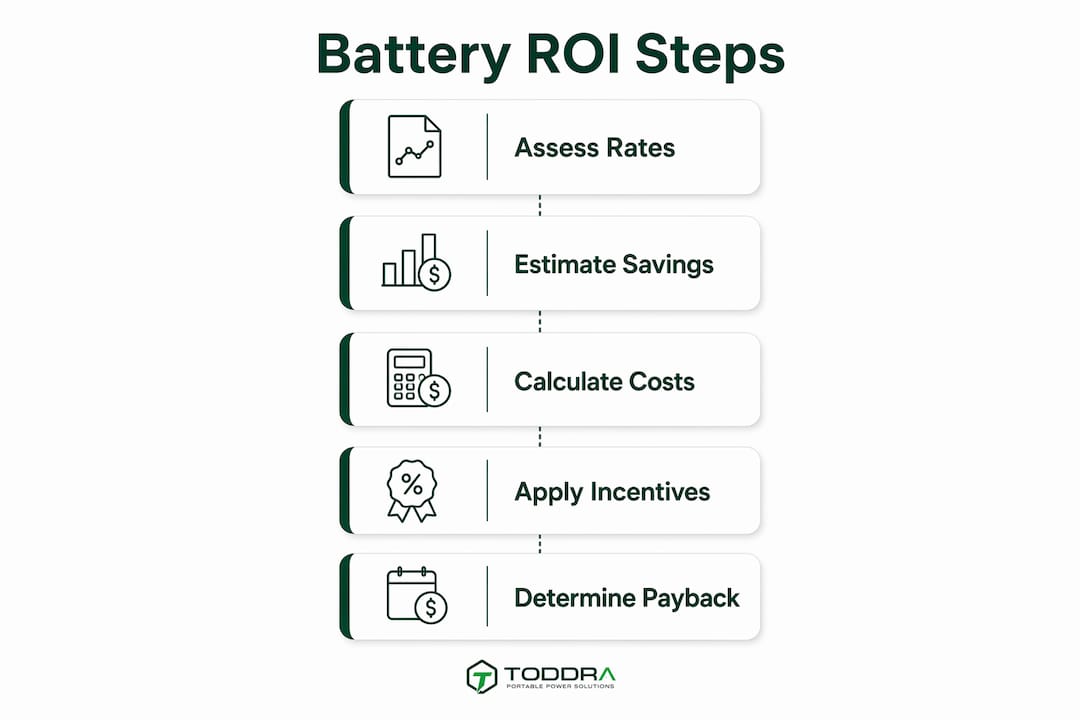
- Find your net system cost. Start with the total installed price. Subtract the 30% federal tax credit. Subtract any state or utility rebates. The result is your actual out-of-pocket cost.
- Estimate annual energy savings. Multiply your daily shiftable kWh by your local peak-to-off-peak rate spread, then multiply by 365. A 10 kWh battery shifting 8 usable kWh per day at a 20-cent spread saves roughly $584 per year.
- Calculate payback period. Divide net cost by annual savings. A $10,500 net cost with $584 annual savings gives a payback period of about 18 years. A 40-cent spread on the same system cuts that to roughly 9 years.
- Factor in round-trip efficiency. Batteries lose energy in the charge-discharge cycle. A 90% round-trip efficiency means 10 kWh in yields only 9 kWh out. Adjust your savings estimate accordingly.
- Account for battery degradation. Most lithium iron phosphate (LiFePO4) batteries retain strong capacity over thousands of cycles, but savings will taper slightly as the battery ages. Build a modest annual decline into your model.
| Scenario | Rate spread | Annual savings | Net cost (after 30% credit) | Payback period |
|---|---|---|---|---|
| Low spread | $0.04/kWh | ~$105 | $10,500 | ~100 years |
| Moderate spread | $0.20/kWh | ~$584 | $10,500 | ~18 years |
| High spread | $0.40/kWh | ~$1,168 | $10,500 | ~9 years |
The table above uses an 8 usable kWh daily shift assumption. Real results vary with usage patterns, battery sizing, and local rates.
Pro Tip: Good ROI models use hourly interval data and factor in round-trip efficiency and battery lifecycle costs. Ask your installer for a dispatch simulation, not just a simple annual savings estimate.
How do regional policies and rate designs shape battery savings?
Location changes the math significantly. Two homeowners with identical systems can see payback periods that differ by a decade based purely on where they live.
- California’s NEM 3.0 (Net Billing Tariff) cut export compensation by roughly 75% compared to prior rates. Homeowners who once profited from selling solar power back to the grid now earn far less per exported kWh. The new economic logic favors storing solar energy and using it during peak hours rather than exporting it.
- Peak import rates in California can run more than triple the midday export credit. That gap makes time-shifting stored solar energy the highest-value use of a battery in that market.
- Midwest and Southeast utilities often have flatter rate structures with smaller peak-to-off-peak spreads. Battery arbitrage savings are lower in those regions, and payback periods stretch longer without strong state incentives to compensate.
- Northeast markets like Massachusetts and New York offer demand response programs and additional incentives that can meaningfully improve battery economics beyond basic TOU arbitrage.
“The shift from export-focused to self-consumption-focused battery strategy is the defining change in residential storage economics for 2026. Homeowners who understand this distinction make far better purchasing decisions.”
Staying current on your utility’s rate design is not a one-time task. Utilities revise tariffs regularly, and a rate change can shift your battery’s annual savings by hundreds of dollars in either direction. Check your utility’s current TOU schedule before finalizing any investment decision.
What are the additional benefits and limitations that affect real-world ROI?
Battery backup systems deliver value beyond the monthly bill reduction, but they also carry real constraints that pure financial models tend to understate.
- Resilience value during outages. A battery that keeps your refrigerator, medical equipment, and lights running during a grid failure avoids costs like food spoilage, hotel stays, or lost remote work hours. These resilience benefits are real but difficult to assign a precise dollar value. For many homeowners, this value alone justifies the investment regardless of the arbitrage math.
- Round-trip efficiency losses. Every charge-discharge cycle loses some energy. A battery rated at 90% round-trip efficiency returns 9 kWh for every 10 kWh stored. That 10% loss reduces your effective savings compared to theoretical calculations.
- Cycling constraints. Batteries have a finite number of charge cycles before capacity degrades. Dispatching the battery too aggressively to capture small rate spreads can shorten its useful life and reduce lifetime ROI.
- Solar opportunity cost. When a solar-paired battery charges from your panels, that energy is no longer exported to the grid. In markets with meaningful export credits, charging from solar means forgoing that export revenue. Your ROI model must compare avoided import costs against forgone export income, not just assume solar charging is always the better choice.
- Modeling accuracy. Simple kWh-shifted calculations overestimate savings. Accurate models simulate actual dispatch logic using local hourly rate data, round-trip efficiency, and realistic cycle assumptions.
The honest picture is that battery backup systems work best for homeowners with high peak rates, strong incentives, and genuine resilience needs. For homeowners with flat rate structures and no outage risk, the financial case is harder to make.
Key takeaways
Home battery backup ROI is determined primarily by your local peak-to-off-peak rate spread, net system cost after incentives, and whether you value resilience alongside direct bill savings.
| Point | Details |
|---|---|
| Rate spread drives ROI | A wider gap between off-peak and peak prices produces faster payback than any hardware discount. |
| Federal credit cuts net cost | The 30% IRS Residential Clean Energy Credit reduces a $15,000 system to $10,500 out of pocket. |
| Financing method matters | Cash purchases minimize total cost; loans add interest that extends payback by years. |
| Resilience has real value | Backup power during outages avoids food loss, medical risk, and lost income even when arbitrage math is thin. |
| Regional policy shapes returns | California’s NEM 3.0 and similar export cuts shift the best strategy from selling power to avoiding peak purchases. |
What I’ve learned about battery ROI that most guides won’t tell you
Most homeowners I talk with focus almost entirely on the hardware price when they research battery storage. They compare specs and costs across systems, then feel confident they’ve done their homework. The rate spread question barely comes up. That is the wrong order of operations.
Your utility’s TOU tariff is the engine of your return. A $500 discount on a battery means almost nothing if your peak-to-off-peak spread is only 4 cents per kWh. That same $500 discount on a system operating in a 40-cent spread market is genuinely meaningful. Pull your utility’s current rate schedule before you request a single quote.
The second thing I’d push back on is the tendency to treat resilience value as a soft, unquantifiable bonus. For families with medical equipment at home, or for property investors managing rental units in outage-prone areas, backup power has a concrete dollar value. A single avoided hotel stay or spoiled refrigerator load is worth real money. Build that into your thinking, even if you can’t put a precise number on it.
Finally, watch your financing assumptions carefully. A loan that looks attractive at 6% interest can quietly double your effective payback period when you account for total interest paid over the loan term. The true cost of solar financing is almost always higher than the monthly payment suggests. Run the full 10-year cash flow, not just the monthly number.
— Jackson
Portable solar and battery solutions from Toddra
For homeowners who want reliable backup power without a full grid-tied installation, portable solar generators offer a practical and flexible path to energy security.

Toddra carries a carefully selected range of high-capacity solar generators and LiFePO4 battery systems designed for home backup, emergency preparedness, and off-grid use. The Jackery Solar Generator 2000 Plus delivers 2,042Wh of capacity and 3,000W of output, enough to run a refrigerator, lights, and essential devices through an extended outage. These systems pair directly with solar panels, charge fast, and require no permits or utility coordination. Browse the full solar generator collection at Toddra to find the right capacity for your household’s needs.
FAQ
What is home battery backup ROI?
Home battery backup ROI is the financial return from installing a battery storage system, calculated by comparing net system cost after incentives against cumulative energy bill savings over the battery’s lifetime.
How long does it take for a home battery to pay for itself?
Payback period depends on your local rate spread and net cost after incentives. A system with a high peak-to-off-peak spread and the 30% federal tax credit applied can achieve payback in roughly 8–12 years in favorable markets.
Does the federal tax credit apply to home battery systems?
Yes. The IRS Residential Clean Energy Credit covers 30% of qualifying battery system costs for systems with at least 3 kWh of capacity, with no annual dollar cap on the credit amount.
How does financing affect battery backup savings?
Cash purchases produce the shortest payback period. Loans add interest costs that extend payback, and leases or power purchase agreements offer monthly savings but no system ownership, which limits long-term ROI.
Is battery backup worth it without solar panels?
A standalone battery can still generate savings through TOU arbitrage by charging from the grid at off-peak rates. However, pairing with solar typically improves ROI by reducing reliance on grid charging and maximizing self-consumption during peak hours.